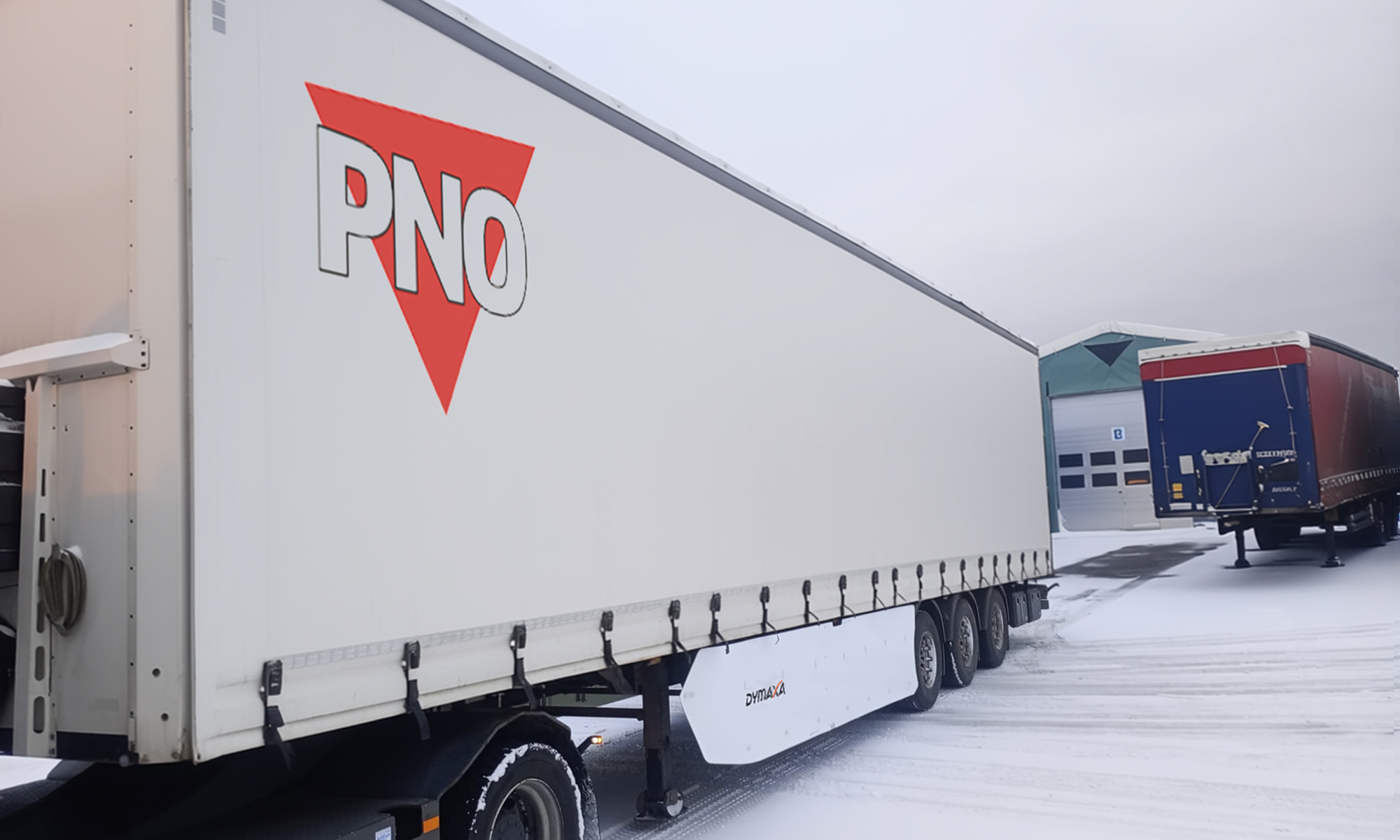
Fleet Upgrade Adds Side Skirts to Cut Truck Emissions

PNO Trailer Rental and Begoma Spedition have equipped a selection of semi-trailers with Dymaxa side skirts. PNO is one of Europe’s largest trailer rental providers and operates 11,000+ semi-trailers. Begoma, one of the most progressive fleets in Sweden, will be operating the trailers. The upgrade supports Begoma’s Agenda 2030 sustainability ambitions.  

Dymaxa side-skirts are designed to boost fuel efficiency for diesel trucks and extend the ranges of electric trucks. PNO expects that Dymaxa side skirts will help reduce fuel consumption and CO₂ emissions. 

With this initiative, customers of PNO can potentially benefit from more energy-efficient state-of-the-art semi-trailers and a greener footprint.

Jan Eriksen, Head of Fleet at PNO: 

By investing in smarter equipment, and optimising our fleet, we actively aim to reduce CO₂ emissions or extend the range on EV trucks pulling a trailer. Sustainability is not driven by a single action, but by continuous improvement – every step, big or small, is a priority for us.

Introducing trailer skirts is one of several important steps in our sustainability strategy and part of our
commitment to reduce our CO₂ emissions by 50 percent by 2030. By lowering aerodynamic drag, we reduce fuel consumption and strengthen both our environmental performance and operational efficiency,

says Henrik Malmberg, Managing Director at Begoma

This retrofit programme forms part of a broader push within the road freight sector to enhance vehicle aerodynamics and reduce operating costs. By minimising drag along the trailer’s underside, side skirts can deliver consistent fuel savings across long-haul operations, particularly at motorway speeds where aerodynamic resistance is highest.

Almaz Ayupov, CEO of Dymaxa adds:

We’re seeing a substantial increase in demand for our side skirts. Many leading European fleets are realizing the efficiency gains are significant, while the solution is easy to implement, requires no training or maintenance, and is relatively low-risk. The North American market has benefited from trailer side skirts for more than a decade, with adoption rate reaching 80%. We are now seeing signs that the European market will follow suit to reduce costs and emissions.

As fleets balance commercial pressures with environmental targets, incremental technologies like this are increasingly viewed as practical, cost-effective steps toward lower-carbon transport. Industry-wide adoption of such measures is expected to play a meaningful role in improving overall fleet efficiency in the years ahead.

BIFA meets UK Chancellor Rachel Reeves to champion logistics priorities

The British International Freight Association (BIFA) policy and compliance director, Pawel Jarza, met with Right Hon Rachel Reeves, Chancellor of the Exchequer, alongside Rachel Taylor MP, to discuss the key challenges and opportunities facing the UK freight forwarding and logistics sector.

Representing BIFA and its members, Jarza highlighted several critical issues impacting the industry. Central to the discussion was the ongoing challenge of attracting and retaining talent within the sector, ensuring the industry remains equipped with the skilled workforce needed to support UK trade and economic growth.

Jarza also raised concerns around freight forwarders’ access to finance, particularly for small and medium-sized enterprises navigating an increasingly complex economic landscape. Ensuring that logistics businesses can secure appropriate funding is vital to maintaining resilience, investment, and competitiveness across the supply chain.

In addition, the meeting addressed the importance of continued improvements to border processes. Efficient, transparent, and streamlined border operations are essential to facilitating trade and minimising disruption for businesses and consumers alike.

The discussion further underscored the need for greater clarity around the road to Net Zero, with BIFA calling for clear, practical guidance to help the industry plan and invest with confidence in sustainable solutions.

BIFA’s points were positively received by all participants. The Chancellor acknowledged the significant contribution the freight forwarding and logistics sector makes to national economic growth, recognising its essential role in keeping UK trade moving.

Commenting on the meeting, Jarza said:

We welcomed the opportunity to engage directly with the Chancellor and Rachel Taylor MP on some of the issues that really matter to our members. Freight forwarders play a critical role in supporting UK businesses and international trade. By addressing challenges around skills, finance, border efficiency, and Net Zero clarity, we can ensure the sector continues to drive economic growth and remain globally competitive.

BIFA looks forward to continuing its constructive engagement with government to help shape policies that support a thriving, efficient, and sustainable freight forwarding and logistics industry.

Powering Competitive Advantage in Energy

Peter MacLeod speaks to Nick Hay of Wattstor, who describes how logistics businesses can go from energy risk to competitive advantage in one fell swoop.

Energy sometimes flies under the radar of logistics operators, yet rising electricity prices, grid constraints and electrification are pushing it firmly into the operational spotlight. For Wattstor, a next-generation energy company supplying commercial and industrial customers with locally produced, smartly managed renewable electricity, that shift represents both challenge and opportunity.

Nick Hay (pictured, below) joined Wattstor last summer as an industry advisor, bringing his decades of logistics experience from senior leadership roles at Fowler Welch and Gist with him. His decision to get involved was rooted in a long-standing interest in efficiency and sustainability, combined with a belief that Wattstor offers something genuinely practical for logistics businesses.

“I have always been close to energy efficiency,” Hay tells me. “From early adoption of telematics through to ESG leadership, I have seen how technology can drive real change. What attracted me to Wattstor was not just the ambition, but the fact that the solution is viable and delivers tangible benefits.”

Operational Realities

At the heart of Wattstor’s proposition is the idea that energy systems should be designed around the operational realities of each site. Warehouses face growing pressure from automation, temperature control and electrification, while grid connectivity is increasingly a limiting factor. As Hay points out, energy availability has already forced some developers to walk away from otherwise attractive logistics locations.

Grid constraints are only part of the challenge. Demand profiles across logistics operations can fluctuate sharply throughout the day, particularly where electric vehicles or handling equipment are involved. Charging fleets simultaneously can create short but significant peaks in demand, driving up costs and network charges.

This is where Wattstor’s combination of onsite renewables, battery energy storage and intelligent energy management comes into play. By balancing grid supply with solar generation and battery capacity, Wattstor helps operators manage peak demand while reducing exposure to rising grid charges.
“The clever part is how you balance those elements,” says Hay. “You reduce the maximum draw from the grid, which lowers fixed charges, while still ensuring the power is there when you need it. When electricity is cheap, you charge the battery. When it is expensive, you avoid buying or export back to the grid.”

That approach underpins Wattstor’s Price Protect tariff, refined with direct input from Hay’s logistics background. Designed to guarantee electricity prices below market levels while providing an absolute price cap, Price Protect also allows customers to benefit when wholesale prices fall. Recent financing of up to £50 million will support the rollout of more than 15 projects over the next two years in both the UK and large parts of mainland Europe, signalling confidence in the model.

Energy Price Hike

With an electricity price hike expected in the UK this April, many logistics operators are already feeling exposed. Amy Wilson, Chief Marketing Officer at Wattstor (pictured, below), says early engagement is critical. “The businesses most affected already know they have an issue,” she explains. “The earlier we assess a customer’s energy profile, the quicker we can identify how to reduce cost, carbon and risk.”

Wattstor’s ability to model a site quickly using existing consumption data allows operators to see potential benefits within days, reflecting the reality that no two logistics operations consume energy in the same way.

A good example is pharmaceutical distributor Mawdsleys, which worked with Wattstor to optimise solar generation across its warehouse estate. The project enabled Mawdsleys to move closer to net zero while overcoming grid limitations and improving long-term cost certainty, without disrupting daily operations.

Longer-Term Prize

Beyond immediate savings, electrification offers a longer-term prize for logistics. Hay argues that predictable electricity pricing could remove one of the sector’s biggest historic variables: “If you can combine electrified fleets with long-term electricity price certainty, you suddenly have far more control over fuel costs. That stability is hugely attractive in a sector built on tight margins.”

Looking ahead, Hay sees energy strategy becoming a competitive differentiator. Operators that understand their energy profiles and act early will be better placed to expand, electrify and absorb future shocks. “Early adopters will do really well,” he concludes. “In a world full of variables, removing uncertainty around energy cost and supply can become a real advantage.”

Subscribe

Get notified about New Episodes of our Podcast, New Magazine Issues and stay updated with our Weekly Newsletter.