Compliance Software for UK CV Fleets in Europe

AiDEN, in collaboration with Volvo Group, has announced a new solution designed to simplify regulatory compliance for truck drivers and fleet operators across Europe. For UK-based fleets — many of which operate extensively across EU markets — this development has important implications for managing cross-border complexity, improving efficiency, and supporting ongoing digitalization efforts post-Brexit.

With UK logistics companies continuing to play a critical role in European supply chains, solutions like this can help streamline operations, reduce friction at borders, and improve overall driver experience —particularly for fleets navigating evolving regulatory requirements across multiple countries.

In December 2024, a new regulatory requirement was introduced in Poland related to SENT (System for Electronic Transport Supervision) for tracking high-risk goods transported within the country. In regard to this, a project to validate one of AiDENS services/products within the platform was initiated. This was done in a project with Volvo Trucks through CampX, Volvo Group’s global innovation arena for technology and business transformation.

It was a successful project leading to high value for the fleet owner and truck drivers enabling seamless compliance with Poland’s SENT without the need for external GPS devices or aftermarket installations. Due to the successful outcomes from the initial project, another phase is now initiated with Volvo Trucks to evaluate further commercial markets during 2026.
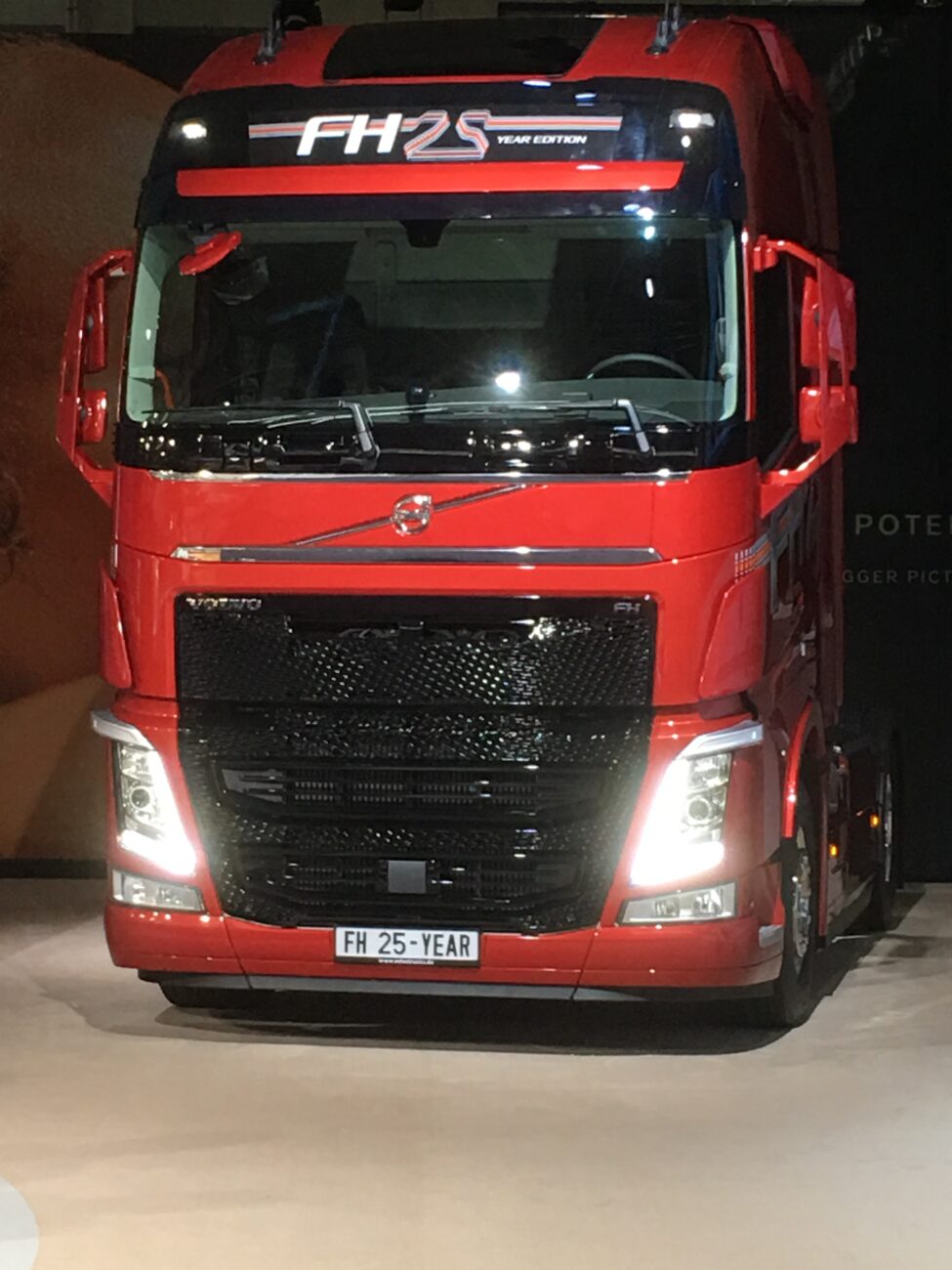
We asked Niclas Gyllenram, CEO of AiDEN Auto, to explain further:

How does AiDEN’s integration with Volvo Trucks address regulatory compliance challenges that are comparable to those faced by UK fleet operators, particularly in areas like customs, cabotage, and emissions reporting?

What we’ve demonstrated with SENT in Poland is that compliance can be embedded directly into the vehicle, rather than managed as a separate operational burden. While the UK has its own regulatory landscape — whether that’s post-Brexit customs processes, emissions zones, or cabotage rules — the underlying challenge is the same: fragmented systems and manual workflows. Our approach is to unify those requirements into a single, in-vehicle interface that automates data capture and reporting. That reduces errors, improves traceability, and ultimately gives operators more confidence that they are compliant without adding complexity to their day-to-day operations.

    The UK logistics sector is dealing with increasing operational complexity post-Brexit—how could a built-in, OEM-native compliance solution like AiDEN’s help reduce administrative burden and cross-border friction for UK hauliers?

    Post-Brexit, UK operators are navigating a much more complex cross-border environment, with additional documentation, checks, and reporting obligations. Traditionally, this has meant more paperwork, more devices, and more time spent managing compliance rather than moving goods. By embedding compliance into the truck itself, we remove much of that friction. Data is captured automatically, reporting can be handled in real time, and drivers don’t need to interact with multiple systems. That translates into fewer delays at borders, fewer compliance risks, and a more streamlined operation overall.

    Given that the initial use case focuses on Poland’s SENT regulation, what lessons from this deployment are most relevant for the UK market, where digital compliance requirements are also evolving?

    One of the key lessons is that operators don’t want more tools — they want fewer, better-integrated ones. In Poland, the biggest value came from eliminating the need for external GPS devices and separate applications, while still meeting strict regulatory requirements. That principle applies equally in the UK. As digital compliance frameworks evolve, success will depend on how seamlessly these requirements can be integrated into existing workflows. If compliance becomes invisible — something that just happens in the background — then adoption becomes much easier and the value becomes immediate.

    UK fleets often rely on a mix of legacy systems and aftermarket solutions—how significant is the shift toward fully integrated, in-vehicle compliance tools in terms of cost savings, uptime, and driver experience?

    It’s a fundamental shift. Aftermarket solutions typically introduce additional hardware, installation time, maintenance, and points of failure. They also create a fragmented experience for drivers, who may need to manage multiple devices or interfaces. By moving to an OEM-native solution, you eliminate those layers. There’s no additional hardware cost, no installation downtime, and far fewer integration challenges. From a driver’s perspective, everything is accessible through a familiar interface. From an operator’s perspective, that means lower total cost of ownership and improved fleet uptime.

    From a broader transportation perspective, how do you see embedded compliance and connectivity platforms reshaping fleet management, safety, and operational efficiency across the UK logistics ecosystem?

    We see this as part of a broader transition toward software-defined vehicles. Compliance is just one entry point, but once you have a secure, connected platform in the vehicle, you can layer in additional services— everything from safety features to operational analytics. For UK fleets, that means moving from reactive management to real-time, data-driven decision-making. It improves safety by ensuring regulatory adherence, enhances efficiency through better visibility, and creates opportunities to optimize routes, reduce emissions, and improve overall performance.

    Following the successful proof-of-value project with Volvo Trucks and the planned evaluation of additional commercial markets in 2026, what are AiDEN’s priorities for expansion into the UK and other European markets, and what criteria determine where you scale next?

    The success of the initial project has validated both the technology and the business case, which is why we are now moving into the next phase to evaluate additional markets. Our expansion strategy is guided by a few key factors: the level of regulatory complexity, the digital maturity of the market, and the presence of strong OEM and fleet partnerships. The UK is naturally a market of interest because of its scale and the operational challenges fleets are facing today. Ultimately, our goal is to bring the same value we’ve demonstrated in Poland — simplifying compliance and reducing operational friction — to fleets across Europe, adapting to each market’s specific regulatory environment while maintaining a consistent, integrated user experience.

      The Hidden Cost of Disjointed Orchestration

      When do small frictions reveal structural problems? Is there a fragmentation tax and a hidden cost of disjointed orchestration in the supply chain? Dima Karlinsky (pictured, below), Chief Business Officer at Unilog SC, explains.

      There’s a moment in every critical Service Level Agreement (SLA) parts network where something small reveals something structural. A part misses a four-hour SLA not because it wasn’t in the country, but because no one was quite sure who owned the handoff. A shipment sits at customs while teams debate who the Importer of Record should have been. Two regions quietly increase safety stock on the same SKU ‘just to be safe’. An escalation call includes five organisations and no single line of accountability.

      Nothing catastrophic. Just friction. Individually, these moments look operational. Together, they are architectural.

      How Fragmentation Creeps In

      Global service parts networks rarely begin fragmented. They evolve that way. A regional specialist is added to close a performance gap. A repair partner shortens turnaround time. A trade advisor manages compliance complexity. A 4PL layer is introduced to connect it all.

      Each decision is rational. Often necessary. But over time, orchestration becomes layered rather than unified. In high-availability environments such as cybersecurity infrastructure, optical networks, data centres and medical systems, that layering begins to create hidden costs.

      Where the Costs Appear

      Fragmentation first shows up in inventory. When regions operate with partial visibility of each other’s positioning, they hedge. The US carries stock to protect its SLA exposure. Europe does the same. APAC does the same again. Individually, the decisions make sense. At the network level, they inflate safety stock, tying up working capital in duplicated buffers that exist purely to compensate for uncertainty.

      It also distorts performance reporting. One provider starts the SLA clock at dispatch, another at delivery attempt. Reverse logistics is measured separately from forward fulfilment. Dashboards appear aligned until volatility hits, and suddenly, no one can reconcile where the delay actually occurred.

      Trade governance becomes another pressure point. In global service networks, customs clearance is not a back-office activity; it is part of the uptime system. When Importer of Record responsibilities shift between providers or vary by region, ambiguity creeps in. A customs hold under a four-hour SLA is no longer just a compliance issue. It becomes a service outage.

      Reverse flows create their own consequences. Repairable assets moving across borders without unified visibility become what operators quietly call ‘dark inventory’. The asset exists somewhere in the network but cannot be deployed when it is needed. The forward network compensates the only way it can, by carrying more stock.

      When problems escalate, fragmentation becomes most visible. In multi-provider models, root cause rarely sits neatly in one organisation. Escalations move sideways before they move forward. Accountability becomes sequential rather than simultaneous. Under stable conditions, the system absorbs that latency. Under disruption, including tariffs, geopolitical shifts and capacity shocks, the latency becomes exposure.

      The Fragmentation Tax

      Multi-provider strategies are often adopted to reduce concentration risk. That logic makes sense.
      But in high-SLA service environments, fragmentation introduces a different risk: coordination failure.
      When orchestration is disjointed, the network begins paying what might be called a fragmentation tax, in duplicated inventory, premium freight, delayed recovery times and the growing overhead required simply to keep the system aligned.


      The tax rarely appears on a single P&L line. It accumulates quietly across buffers, expediting, working capital and management attention.

      A Different Question

      As global service networks expand and trade regimes tighten, leaders are starting to ask different questions. Not ‘Are our providers performing?’ but ‘Is our orchestration structurally unified?’, because in high-availability service networks, architecture is no longer just an operational choice. It is a resilience strategy. Every network pays for its design. The only question is whether the cost is visible.

      CubeVerse Platform Launched for Fulfilment

      AutoStore™, a global supplier of intelligent fulfillment, today announces the ‘CubeVerse’ platform and new AI-driven capabilities, aimed to mark a major step toward self-optimizing fulfillment. AutoStore is introducing new cloud software, AI-powered analytics, and robotic workflows for order preparation and system optimization that can deliver higher throughput in existing systems without additional hardware.

      After more than two decades of pioneering cube storage automation, AutoStore is now moving beyond automation alone toward intelligent fulfillment systems that continuously sense, decide, and improve in real time. The announcement reflects a shift in the market from asset-centric automation to decision-centric fulfillment, as companies look to connect machines, software, data, and people into more intelligent, coordinated operations. With CubeVerse and AutoStore Intelligence, AutoStore enables better, faster decisions across design, deployment, operations, and optimization—working alongside existing WMS and WES solutions rather than replacing them.

      For customers, this means unlocking hidden capacity in existing systems, simplifying operations, and accelerating the path to fully autonomous fulfillment, powered by learnings continuously drawn from AutoStore’s global community of thousands of live systems, enabling improvements that compound across the installed base.

      “Fulfillment is becoming a real-time, intelligence-driven discipline. If systems can’t sense, decide, and adapt continuously, everything upstream breaks,” said Parth Joshi, Chief Product Officer at AutoStore. “With the launch of the CubeVerse platform and our AI-driven capabilities, we’re bringing intelligence across the entire lifecycle — from design to daily operations to advanced analytics to optimizations. This is a major first step in our AI strategy and reinforces our focus on innovation as the market leader in automated fulfillment.”

      The Spring 2026 product announcement introduces a new CubeVerse cloud platform, designed to unify data, applications, and AI capabilities across the fulfillment lifecycle, alongside AI-powered software and analytics, and expanded automation capabilities. Together, these capabilities lower total cost of ownership, improve performance and predictability, reduce operational complexity, and support longer operating hours, including full 24/7 operation.

      After a decade of rapid investment in warehouse automation, the industry is facing a new challenge:
      seventy-five percent of companies say synchronizing their supply chain is difficult as logistics networks grow more complex. The question is no longer just how to automate, but how to coordinate machines, software, data, and people into systems that make better decisions and run reliably around the clock.
      CubeVerse and AutoStore Intelligence provide the data, simulation, and analytics capabilities that enable this shift — helping customers orchestrate fulfillment decisions across the system lifecycle without replacing existing orchestration or control layers.

      The Spring 2026 Product Portfolio

      Built on the CubeVerse platform, this Spring’s announcements span the fulfillment lifecycle—from system design and AI-driven optimization to autonomous order preparation.

      CubeVerse™ Platform
      CubeVerse provides a single platform to design, deploy, and run AutoStore systems. It spans the full system lifecycle—from design and simulation to deployment, operations, analytics, and optimization.
      CubeVerse simplifies integrations, keeps operations consistent across sites, and helps customers avoid overbuilding and keep costs under control.

      AutoStore Intelligence
      AutoStore Intelligence applies built-in AI to real operational data across the platform to orchestrate fulfillment in real time. It optimizes robot movement through CubeControl, reduces congestion, and clears traffic bottlenecks to deliver significantly higher throughput during peak periods, with
      performance continuously improving over time, without requiring additional robots or grid
      expansion. Embedded across CubeVerse, AutoStore Intelligence uses 20+ proprietary models to predict issues, optimize operations, and deliver measurable performance improvements across the automation lifecycle.

      CubeAnalytics™
      CubeAnalytics, powered by AutoStore Intelligence, turns system data into clear, real-time insights and recommended actions. It helps teams identify issues earlier, reduce downtime, and rely less on specialized in-house expertise. With built-in AI, CubeAnalytics automatically surfaces key issues and patterns, evolving from reporting into an intelligent system that recommends action automatically.

      CubeControl™
      CubeControl, powered by AutoStore Intelligence, uses AI to personalize routing parameters and create optimized robot highways for large, robot-dense grids. This improves traffic flow, reduces congestion, and boosts overall system throughput without additional hardware.

      VersaAI™
      VersaAI delivers robotic piece picking powered by vision and AI, expanding AutoStore’s automation portfolio into autonomous order preparation. The system automates order preparation, consolidation, and staging, improving overall AutoStore utilization. It enables operations to run longer hours with consistent throughput and lower cost per order. This supports 24/7 operations without sacrificing performance.

      CubeStudio™
      First major application added to the CubeVerse platform, CubeStudio is a shared, cloud-based environment for system design, simulation, and validation, enabling AutoStore and partners to make data-led decisions together. It serves as an early proof point of AutoStore’s modern app strategy powered by CubeVerse.

      Cube Enhancements
      New workstation layouts and expanded bin and case support give customers more flexibility as volumes, SKUs, and workflows change, without requiring grid rebuilds. Enhancements based on partner and customer feedback include expanded case support in AutoCase, simplified WMS integration through VersaPort, and upgraded industrial PCs for large, high-performance systems.

      Advanced Automation for ecommerce Packaging

      The structural growth of ecommerce is transforming the organization of logistics centres. The increase in shipping volumes, the progressive fragmentation of orders and the demand for more sustainable packaging are imposing new standards of flexibility and control on warehouses.

      Coesia, among the 1600+ exhibitors at LogiMAT, in Hall 8 – Booth 8C21, seeks to respond to this need with an integrated portfolio covering packaging, handling and palletizing, aiming to position itself as a technology partner capable of operating consistently across the entire order fulfillment flow.

      “Ecommerce has transformed the warehouse into an environment where every order is a case of its own. Different products, different formats, different timing, and the constant need to optimize every phase,” says Alessandro Parimbelli, CEO of Coesia. “The solutions we bring to LogiMAT come from this context: automation that adapts to the real flow of operations, not the other way around. Every shipment with empty space is a cost that someone ultimately pays — whether the manufacturer, the distributor or the planet. Our goal is to eliminate such costs through packaging that adapts to the product and delivers measurable results from the very day one. Our approach brings together the key elements of mechanical automation, digital integration and modular architecture. In this way, customers can configure lines that closely match their processes, improving operational efficiency and optimizing the use of packaging materials.”

      According to recent market analyses,the global market for automated e-commerce packaging solutions is expected to grow at a compound annual rate of over 16% in the next five years, driven by the need to reduce operating costs, increase fulfillment speed and optimize shipping volumes. Warehouses must be able to handle heterogeneous products in terms of size and characteristics while maintaining high standards for traceability, accuracy and speed in order preparation. Automation therefore represents a decisive factor in ensuring operational continuity, cost control and service quality.

      Solutions on show

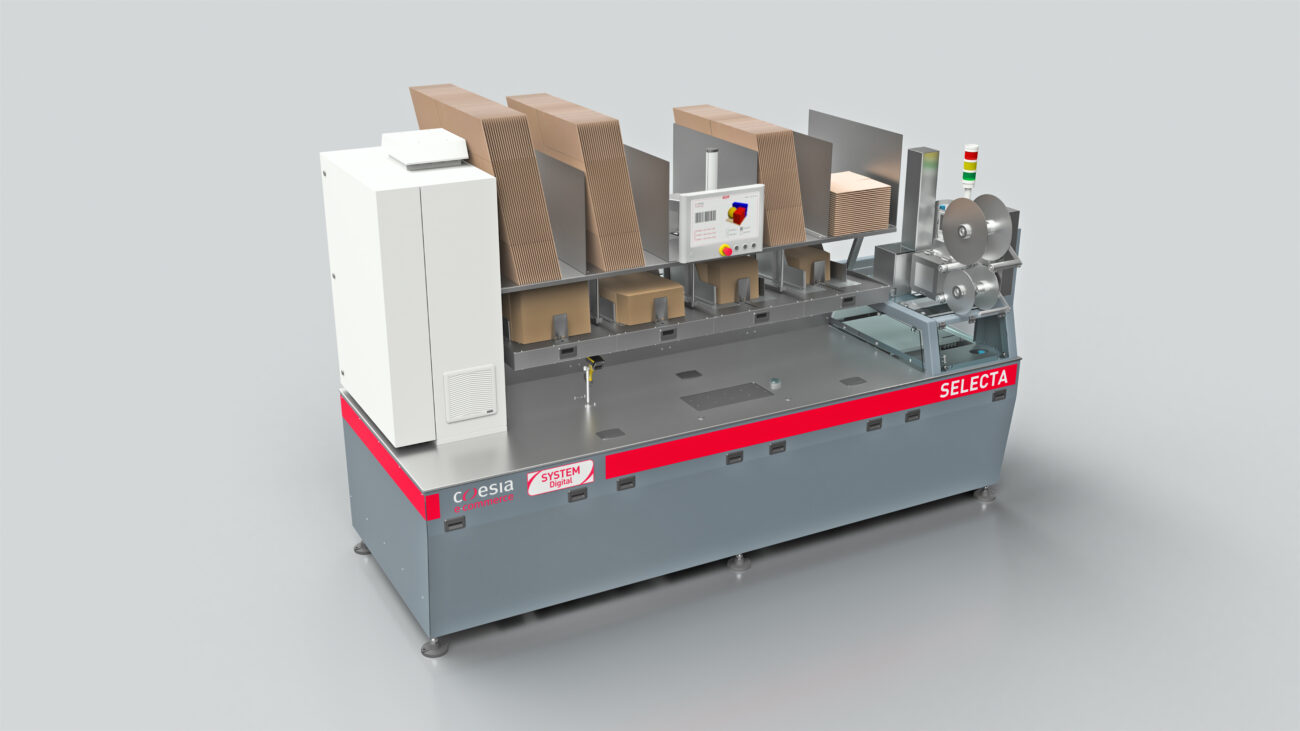
      SELECTA is System Digital’s solution — a Coesia Group company — for the automated handling of pre-formed paper bags in ecommerce fulfillment. The system is designed to eliminate one of the most common bottlenecks in packaging operations: the manual selection of the most suitable format for the product.

      Once it receives the dimensional data of the product from the customer’s management system or through direct acquisition via incoming scanning, SELECTA automatically selects the correct bag among the formats available in stock. The bag is then picked, opened and presented to the operator in an ergonomic position for quick loading. Once the product is inserted, the system performs the sealing, applies the shipping label and transfers the package to the outgoing line, ready for logistics.

      The result is a faster, more precise and more sustainable process. Packaging calibrated to the product means less material used, reduced shipping volumes and a customer experience cared for down to the last detail. SELECTA manages five bag formats — from Small (300×250 mm) to XXL (600×450 mm) — with productivity of up to 530 pieces per hour in a fully automated configuration.

      System Digital – ELEVA

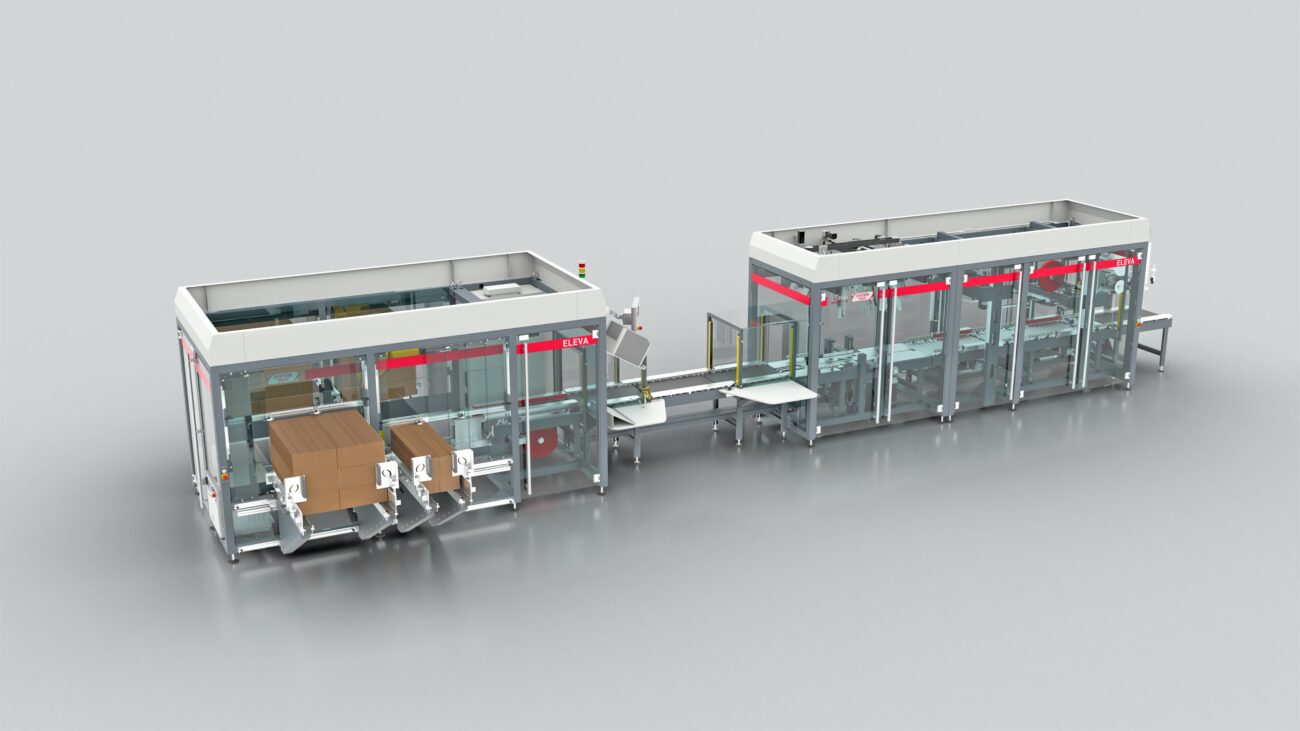
      ELEVA is System Digital’s modular platform for the automated handling of corrugated cardboard boxes in intralogistics. The system integrates functional modules for box erecting, dynamic height adjustment, closing and labeling. The height-reduction module operates continuously rather than discretely, processing boxes with different bases in sequence without requiring mechanical changeovers between formats. ELEVA reads the height of the inserted product and automatically adjusts the cardboard, eliminating empty space, improving load stability and reducing transport costs. Throughput reaches up to 600 units per hour.

      The modular architecture is designed to evolve over time, with each module able to be operated independently or integrated into a complete line, allowing the system to be configured according to the available layout and the desired level of automation. At LogiMAT 2026, ELEVA will be presented through technical materials and dedicated insights at the booth.

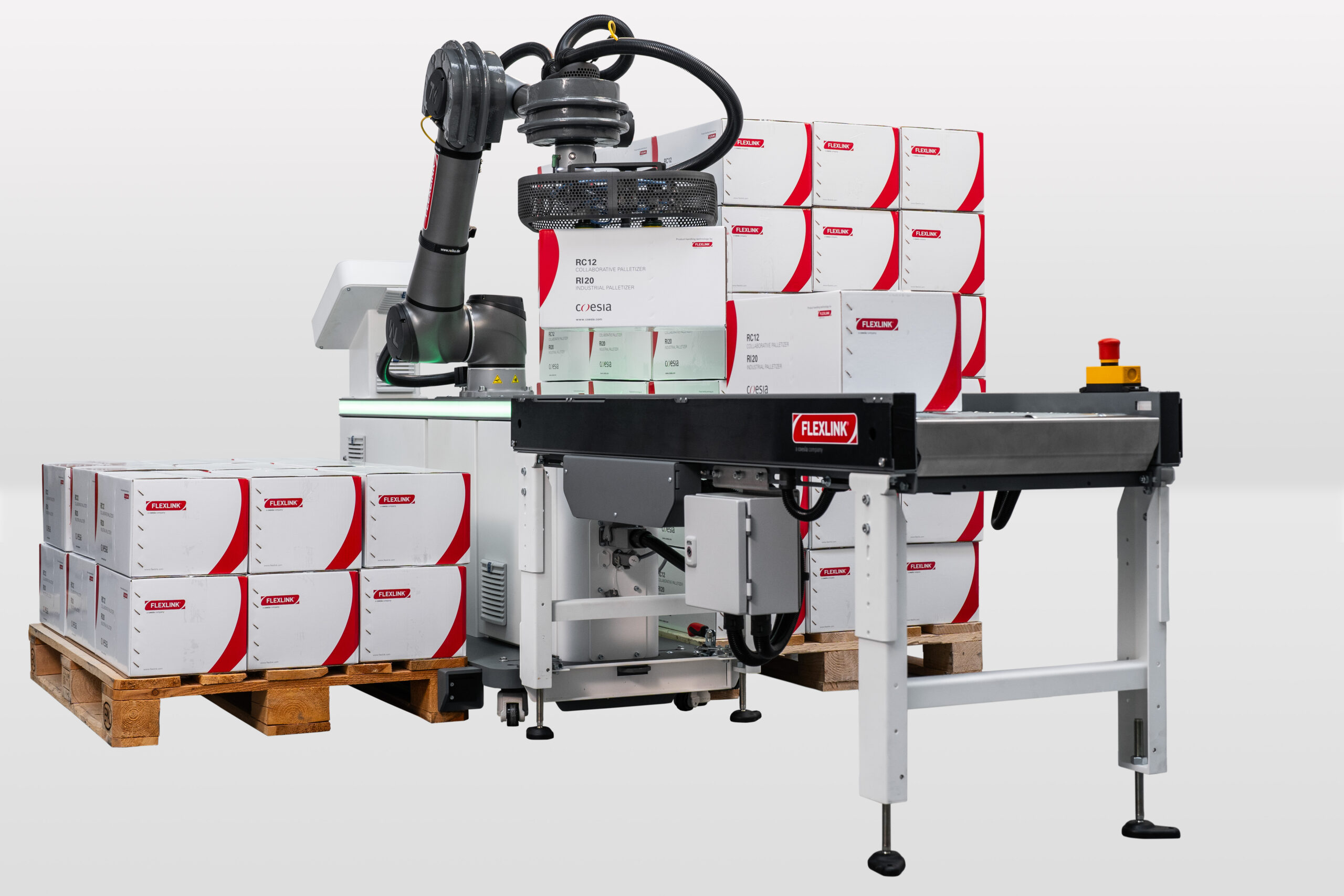
      Completing the logistics offering, Coesia presents RC12 by FlexLink, a collaborative palletizing system designed for flexible applications in warehouses and distribution centres. RC12 integrates a collaborative robot for pallet handling and re-organization, facilitating transfer operations and load reconfiguration according to operational needs. The configuration interface allows palletizing patterns to be defined quickly, facilitating adaptation to the variable flows typical of e-commerce and modern distribution.

      Emergency Multimodal Solutions Deployed for UAE

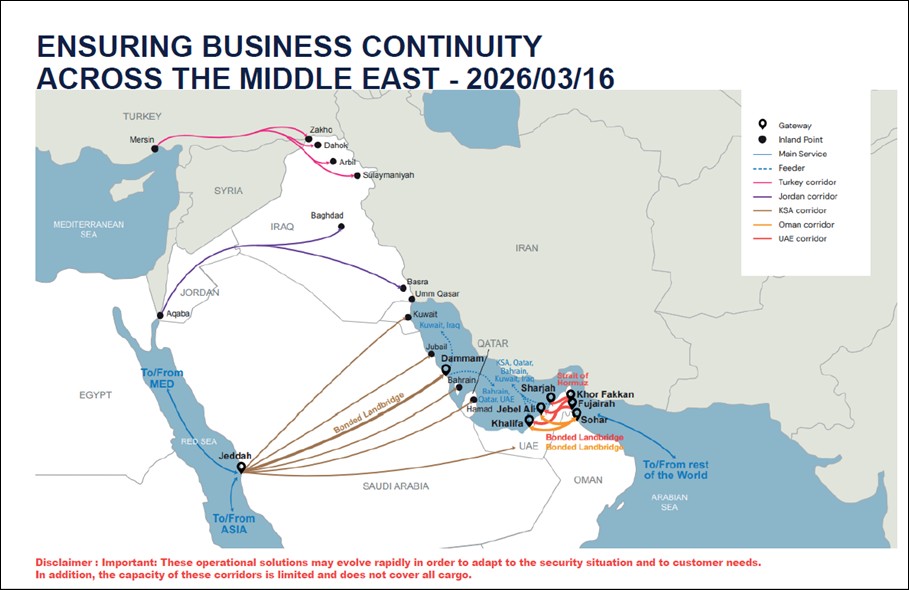
      Given the situation in the Middle East and restrictions affecting maritime traffic in the Strait of Hormuz, CMA CGM says its top priority remains the safety of its crews and employees. In this context of significant navigational constraints, the company is mobilizing to support its customers’ supply chains and ensure continuity of trade to and from the Middle East.

      Leveraging the agility of its global network and its integrated logistics capabilities, the Group is deploying alternative multimodal solutions combining sea, rail, and road transport to maintain the smooth flow of logistics despite the situation in Hormuz.

      Secure logistics corridors via the United Arab Emirates: Located south of the Strait of Hormuz, Khor Fakkan, Fujairah, and Sohar serve as strategic entry points for Gulf-bound flows.

      From these ports, CMA CGM offers logistics corridors to serve:
      • The main hubs in the UAE (Khalifa, Jebel Ali, Sharjah)
      • Other countries bordering the Arabian Gulf via a combination of regional road and maritime transport

      This multimodal organization ensures continuity and efficiency of supply chains in the region.

      Alternative road corridor via Saudi Arabia

      The port of Jeddah on the Red Sea also provides an alternative to passing through the Strait of Hormuz. From Jeddah, CMA CGM has established road corridors, with or without maritime connections, for onward delivery to Saudi Arabia (Dammam), the UAE, Qatar, Bahrain, Kuwait, and Iraq. This setup also allows flows to connect to the Mediterranean and Asia without exposure to the strait.

      Complementary road solution via Oman

      CMA CGM also leverages Omani ports to provide a third major alternative road route. These ports enable road connections to the UAE and northern Gulf countries combining road and feeder services, offering a reliable alternative for regional and cross-border flows.

      Through this setup, CMA CGM aims to use its ability to manage geopolitical risks and provide robust, flexible, and secure logistics solutions in support of international trade.

      Poland–UK Logistics Shows Stable Return Ratios

      Cross-border parcel flows from Poland to the United Kingdom show that return rates remain operationally manageable, reaching an average of 2.8% across analysed shipments in 2025. The analysis is based on shipment and return data from 502 exporters, structured using HS (Harmonized System) codes assigned at customs clearance. This allows for detailed tracking of product flows, return frequency and category-level performance across the Poland–UK corridor. What are the biggest logistical challenges in the area of returns?

      From a logistics perspective, the data indicates that cross-border shipping to the UK is no longer treated as an unstable or experimental route. Instead, it operates as a predictable flow with measurable return ratios and defined cost structures.

      Shipment structure reflects diversified parcel flows

      The structure of shipments is distributed across multiple product categories:

      Home & Interior – 24.10%
      Beauty – 15.14%
      Garden – 12.52%
      Supplements & Vitamins – 7.82%
      Clothing – 5.85%
      Toys & Sports – 5.54%
      Footwear – 5.09%

      The distribution shows that parcel flows are not concentrated in high-return segments such as fashion. A significant share comes from categories typically associated with lower reverse logistics pressure and more predictable fulfilment processes.

      Returns are not a barrier to entering the UK market

      “There is still a persistent myth surrounding sales to the UK, particularly in the fashion segment, that return risk is high. Our data shows something different. Even in clothing and footwear, we are not talking about levels that could destabilise a business. It is not a barrier to entry. It is a parameter of the category that should be built into the business model.” says Paweł Zakielarz, CEO of Global24 & Shopreturns.
      “Even in clothing and footwear we are not seeing levels that could destabilise a business. Returns are not a barrier to entry, they are simply a parameter of the category that should be incorporated into the business model.”

      Zakielarz notes that the perception of the UK market has evolved in recent years:

      “After Brexit, many sellers paused expansion plans. Today we see a clear shift. Cross-border has become part of long-term international strategy rather than a test market. The relatively low return rate suggests that sellers increasingly understand both customs requirements and the expectations of British consumers.”

      Marketplace ecosystems raise the bar

      International expansion increasingly takes place within marketplace ecosystems, where return rates influence seller performance indicators. In such environments, returns are not only a logistics cost but also a factor affecting offer visibility and sales performance. Lower return levels may indicate better product-market alignment and more accurate product communication.

      Industry observers note that cross-border expansion is no longer limited to large enterprises. Specialised brands in sectors such as home, beauty and supplements are increasingly building international presence through selected marketplaces.

      What are the biggest logistical challenges in the area of returns?

      Returns in cross-border logistics are among the most operationally complex processes in the entire supply chain. They require coordination of multiple elements simultaneously – from organising reverse transport and handling customs clearance, to managing costs and delivery times, as well as efficient processing of returned goods in warehouses. An additional challenge is the unpredictability of volumes and regulatory differences between markets, which can impact both the time and cost of return handling. As a result, effective reverse logistics management is no longer just an operational issue, but a key factor influencing the profitability of international sales.

      In the traditional returns model, the process remains costly, time-consuming, and difficult to control. Returns are often handled via expensive international shipments paid for by the customer, without full tracking capabilities or real-time status verification. There is also a lack of effective quantity and quality control mechanisms, which complicates further inventory management. An additional challenge is the inability to meet the requirements of marketplaces such as Amazon, Zalando, or eBay, where return handling standards are becoming increasingly stringent. Moreover, each individual return generates high CO₂ emissions due to the need for international transportation.

      Shein Launches Major Logistics Centre in Poland

      “The Shopreturns model changes this perspective by shifting return handling to the local level. Returns are processed by local couriers, with full tracking and scanning within 24 hours, significantly reducing operational time. Thanks to local return centres, costs are lower and the process becomes more predictable. Each return can undergo quantity and quality control, supported by photo documentation, enabling faster decision-making and improved process control. The solution has been designed in line with the requirements of major marketplaces, facilitating international sales. At the same time, localising returns reduces the need for long-distance transport, resulting in a significant reduction in CO₂ emissions,” adds Zakielarz.

      From a logistics industry perspective, the growing importance of returns management indicates a clear shift in the role of operators within the supply chain. Reverse logistics is no longer a supplementary service but is becoming an integral element of cross-border process design – on par with first-mile delivery. Companies that are able to optimise return handling at the local level gain not only a cost advantage, but also greater operational control and compliance with marketplace requirements. In practice, this means that the efficiency of returns logistics is increasingly determining the scalability of the entire international sales model.

      Subscribe

      Get notified about New Episodes of our Podcast, New Magazine Issues and stay updated with our Weekly Newsletter.