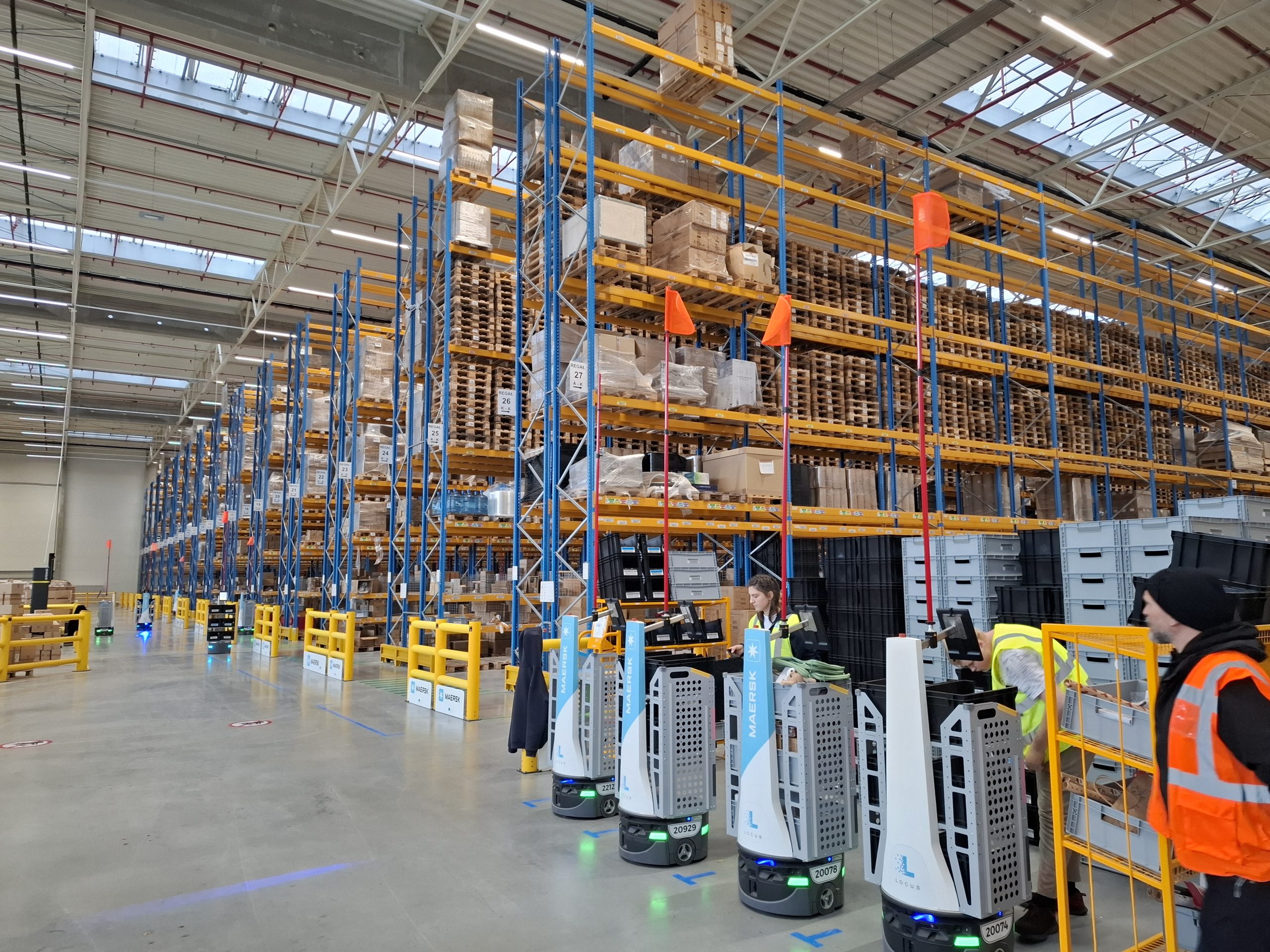
An exclusive site visit as Peter MacLeod reports from a Maersk DC in chilly Wrocław, Poland, where Locus Robotics has provided an automated solution to fulfil Flying Tiger’s Europe-wide e-commerce orders.
When Maersk set out to transform its e-commerce fulfilment operation for its Danish retailer customer Flying Tiger, it faced a familiar modern logistics dilemma: how to scale rapidly, cope with extreme seasonal peaks, and maintain service levels, all within the constraints of an existing warehouse footprint and with tight implementation timelines.
The answer at its Wrocław facility in southern Poland came in the form of autonomous mobile robotics from Locus Robotics. I was lucky enough to be invited for a tour of this impressive site which, albeit not one of Locus’ largest installations by far, nevertheless highlights in a nutshell what cutting-edge robotics can bring to a project to drive efficiency and cost savings. My visit just so happened to be during the Christmas peak, which gave me particular insight into how well things were going.
The site serves as the central European hub for all of Flying Tiger’s European online orders (retail fulfilment remains out of Copenhagen), shipping orders across the EU from a single 5,700 sqm operation. Since going live in May 2023, it has become a showcase for how robot-assisted picking can deliver speed, flexibility and cost control in a fast-growing retail environment.
High-Growth Under Pressure
Flying Tiger is no small retail brand. With 926 stores worldwide and a highly dynamic product range, its e-commerce channel has been growing rapidly. At the Wrocław site alone, Maersk handled 230,908 parcels in 2023, rising to 392,980 in 2024, with over 528,000 forecast for 2025 at my time of visit. The operation manages between 2,800 and 3,500 SKUs at any one time, with demand patterns heavily influenced by social media trends, seasonal peaks and promotional activity.
Before automation, the pick process was struggling. Manual productivity was running at around 40 order lines per person per hour, well below the 120 lines per hour target. The operation was characterised by long walking distances (up to 20,000 steps per picker per day), aisle congestion, heavy trolleys, long onboarding times and a growing risk of errors and injuries.
With Q4 volumes peaking at five times the average and only 22 weeks before the next peak season, Maersk needed a solution that could be deployed quickly, scaled easily, and funded in a way that avoided heavy capital expenditure.
Bots to the Rescue
After analysing a range of goods-to-person and person-to-goods automation options, Maersk selected a
mobile robot ‘person-to-goods’ RaaS (Robots-as-a-Service) model offered by Locus Robotics. The decision was driven by several key criteria: flexibility, rapid deployment, low upfront cost, ease of integration and the ability to scale both labour and automation in line with demand.
The RaaS commercial model was particularly attractive, for instead of committing to a fixed fleet size,
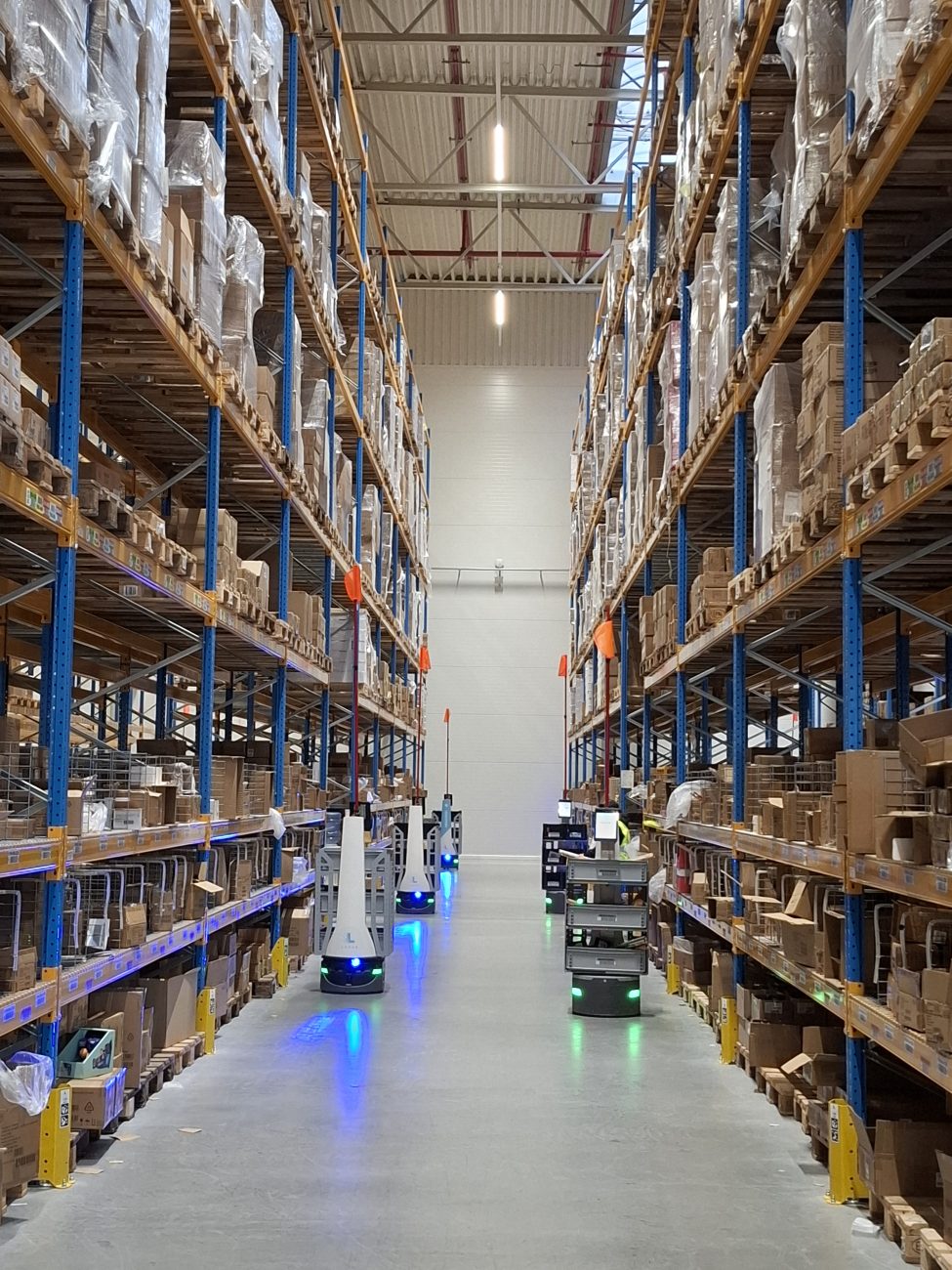
Maersk can scale robots up and down according to volume. This was an important advantage for a business shaped by influencer-driven spikes and intense seasonal surges. Just as importantly, the solution could be implemented in the existing building, which has a height limit of 12.2 m and no scope for major structural changes.
From decision to go-live took just 16–18 weeks, a timeline that was later recognised by Locus as one of its fastest and best implementations in Europe.
How it Works
At the heart of the operation is a fleet of Locus Origin robots, a nimble autonomous mobile robot designed for collaborative picking. Associates remain in their aisles while robots travel between locations, presenting the next task and carrying multiple totes for batch and multi-order picking.
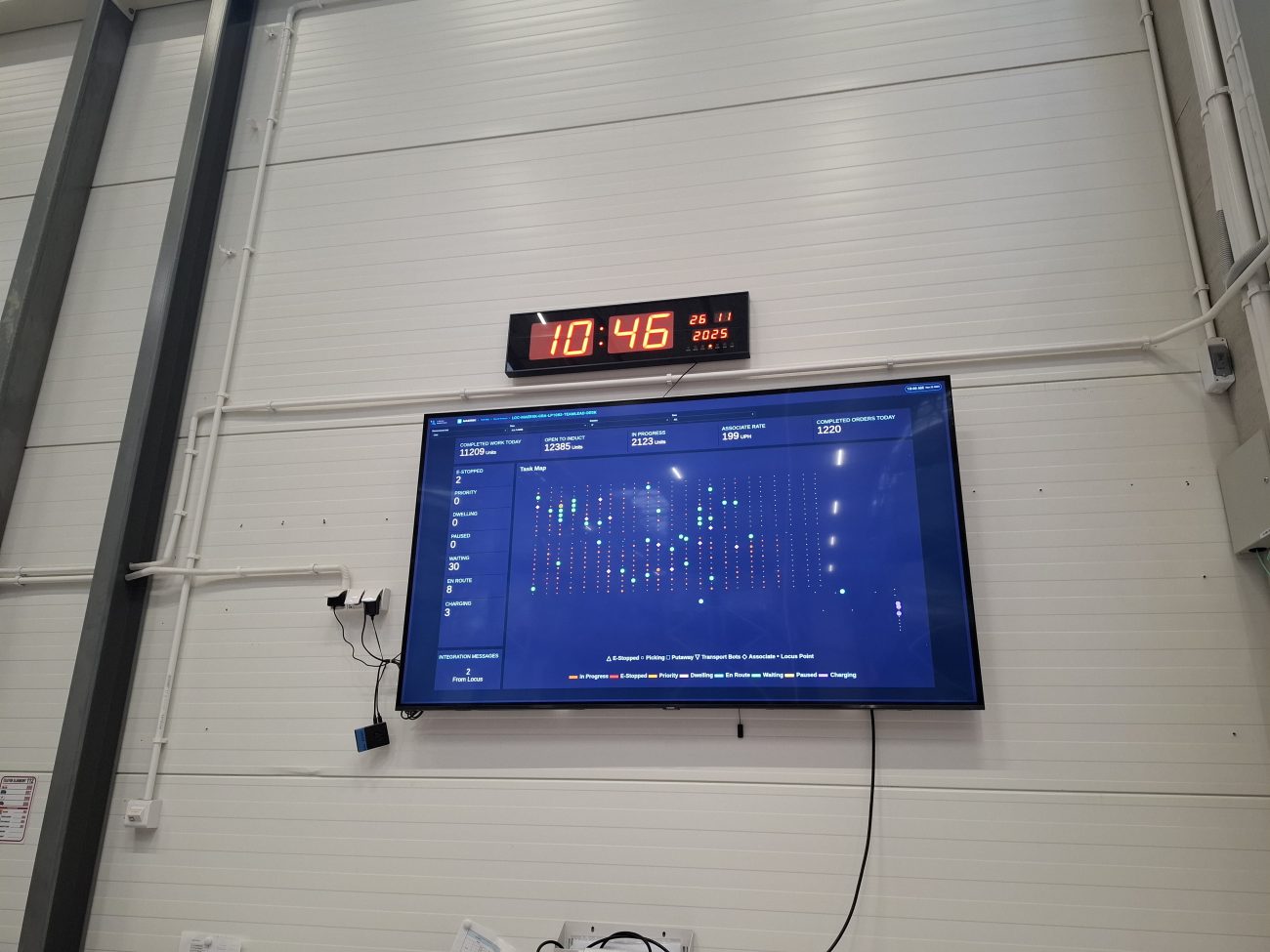
Orders are orchestrated by the LocusONE platform, which integrates with Maersk’s INFOR WMS and dynamically clusters tasks to optimise pick paths, balance workloads and maintain service level priorities. The system supports multiple workflows, including batch picking, pick-and-pass, and point-to-point transport, enabling Maersk to adapt processes as volumes and profiles change.
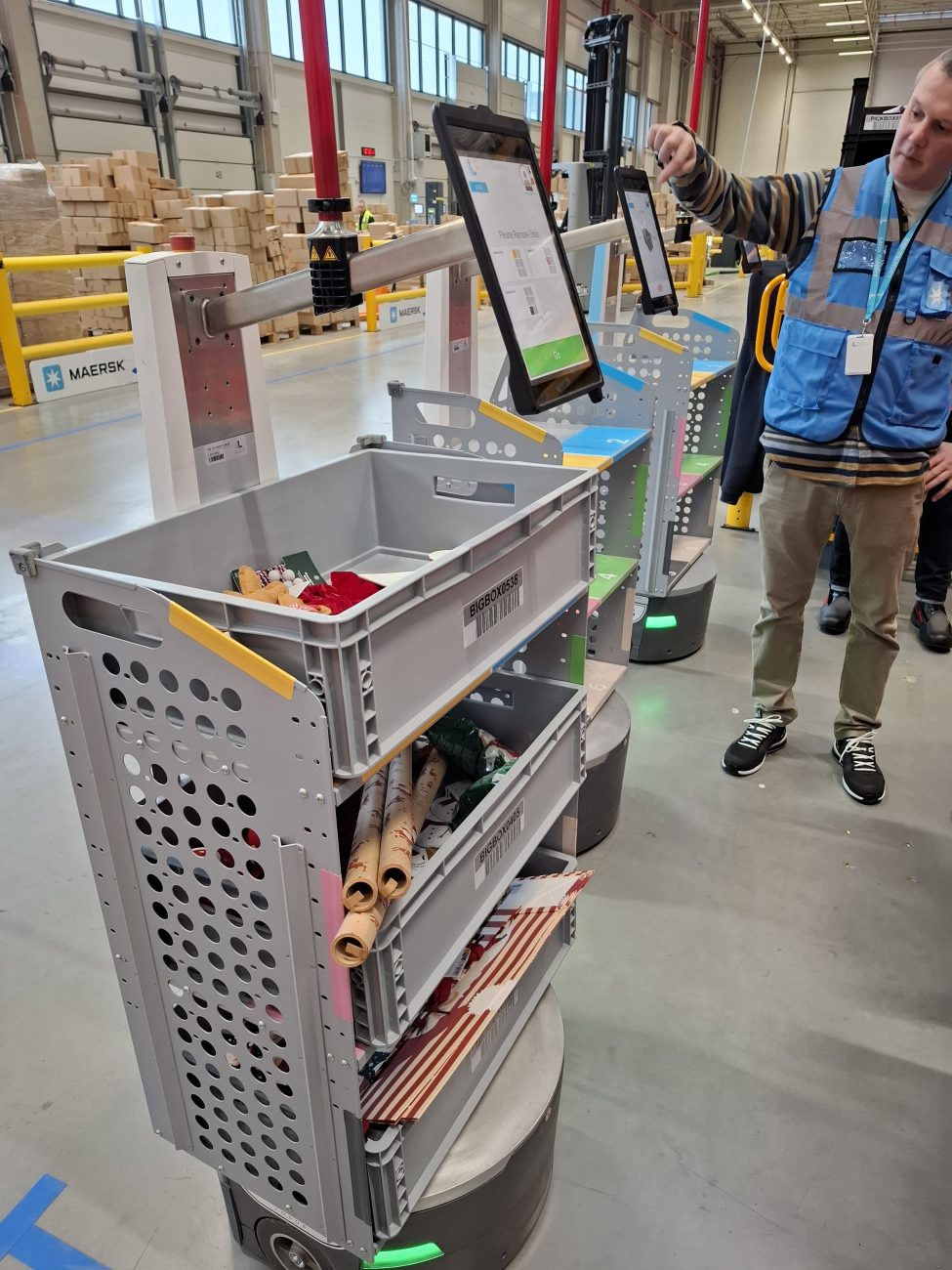
Each robot guides the associate through the pick with a clear, multilingual interface (important to have in this region of Europe, close to the Czech/Slovakian borders), product images, tote position indicators and
built-in scanning. Locus’s patented autoidentification technology recognises the worker based on proximity, automatically switching the screen language to the associate’s preferred setting, a major benefit in such a multicultural workforce.
Navigation and fleet management are handled by proprietary AI, which continuously optimises routes,
avoids obstacles and balances robot traffic across the floor. The result is a system that can be deployed in
brownfield environments with minimal infrastructure changes and no fixed conveyors.
The impact at Wrocław has been dramatic. Pick productivity has increased from 40 to 140 order lines per hour – a 250% improvement, if my maths is right. Onboarding time for new staff has been reduced from three days to just 20 minutes. Average walking distance has dropped from 20,000 steps to around 8,000 per day, significantly reducing fatigue.
The number of active packing stations has been increased from 16 to 40, and despite a reduction in available aisles for picking, overall throughput has increased substantially. Service performance has improved too, with 60–100% of parcels now shipped within 24 hours, and the Christmas cut-off date brought forward by six days compared to 2023. As I stood there watching order pass by in front of me, Flying Tiger seemed to be doing a – pardon the pun – ‘roaring’ trade in seasonal wrapping paper.
From a financial perspective, the results are equally compelling. Maersk has said that the introduction of Locus has significantly reduced pick process costs, equating to a 33% saving even after including the robot service fees. Forecasts for full-year 2025 point to a further 24% cost reduction.
There have also been significant soft benefits. For example, the site has recorded zero push-and-pull
injuries, sick leave has fallen by 15%, and employee retention has improved by 8%, reflecting a more attractive, less physically demanding type of work. I love to hear about those sorts of benefits.
Flexibility and Scale
For Locus, the Wrocław project is a textbook example of its core value proposition, namely unmatched flexibility and unlimited throughput. Unlike fixed automation, the Locus approach allows Maersk to add or remove robots in minutes, introduce new workflows without disruption, scale from dozens to hundreds of robots as volumes grow, and operate across multiple shifts or 24/7 without physical reconfiguration.
The platform has already proven capable of supporting 25,000+ units per hour on a single site and handling 150,000 lines in a single day in other deployments. While the Wrocław operation does not yet operate at those extremes, the architecture ensures that throughput can grow well beyond current requirements.
Crucially for Maersk, this flexibility aligns perfectly with Flying Tiger’s volatile demand profile. Whether
reacting to a viral social media trend or preparing for a Q4 surge, capacity can be adjusted simply by deploying more robots.
European Blueprint
The Wrocław project was Locus’s first major automation deployment in Europe with Maersk and is already being viewed as a blueprint for other sites. The modular nature of the installation makes it easy to replicate in additional warehouses. From Maersk’s perspective, the collaboration has demonstrated that high levels of automation do not require long lead times, heavy CapEx or purpose-built facilities. Instead, robotics can be layered onto existing operations to deliver rapid, measurable improvements.
For Flying Tiger, it means faster order fulfilment, better service levels for customers across Europe, and the confidence that its logistics partner can keep pace with growth.
A Modern Model
As European ecommerce continues to grow, and as labour markets remain tight, the Maersk–Locus–Flying Tiger partnership offers a compelling model for other retailers and 3PLs. By choosing a flexible, rapidly deployable robotic solution, Maersk has transformed a struggling manual process into a highperformance
fulfilment engine capable of absorbing growth, coping with volatility, and delivering measurable financial returns.
For Locus Robotics, Wrocław stands as a high-profile demonstration of how its technology can support complex, high-growth operations in real-world conditions. And for Flying Tiger’s customers across Europe, it simply means their colourful household items, party accessories and impulse buys will arrive faster and more reliably than ever.